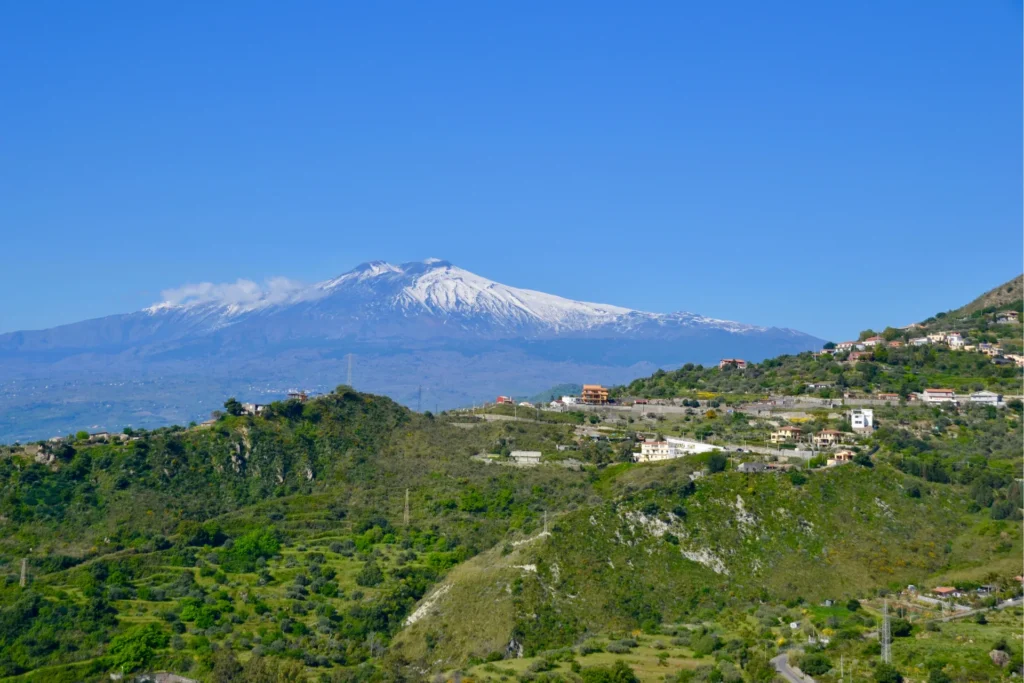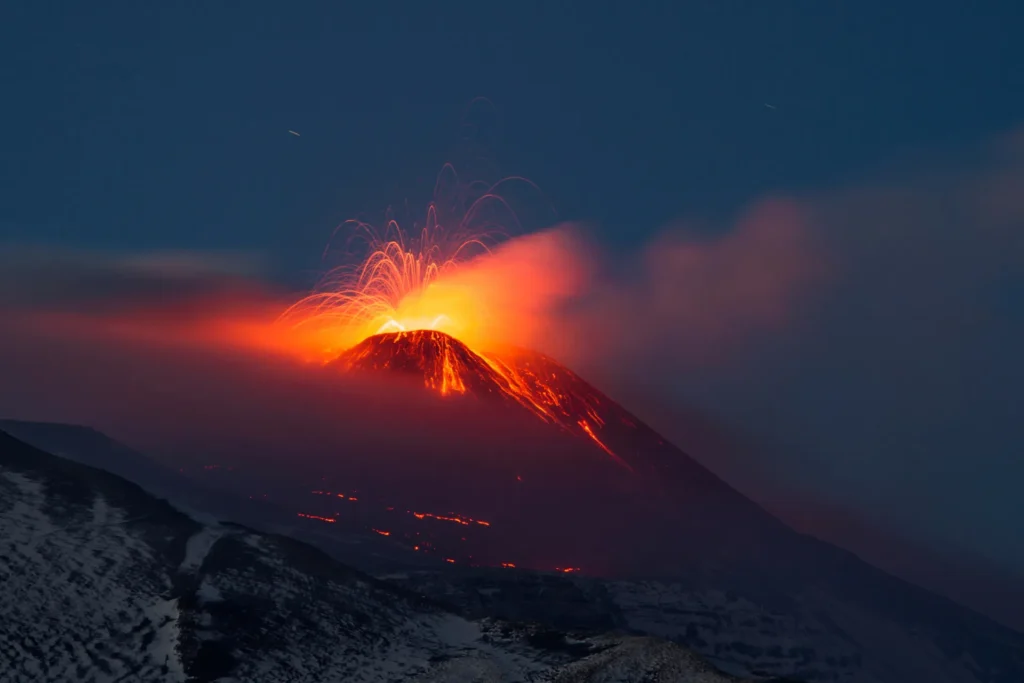
Etna is the largest volcano in Europe and one of the most active volcano in the world. In Greek Mythology,
the deadly monster Typhon was trapped under this mountain by Zeus, the god of the sky and thunder and
king of gods, and the forges of Hephaestus were said to also be located underneath it.
The majortiy of the activities and eruptions occur on the summit, where there are at the moment four
craters. Voragine and Bocca Nuova were both formed by an eruption in the main Central Crater
respectively in 1945 and 1968. The third is the North-east Crater (1911) which is at the moment the highest
crater on Etna with its 3330 meters. The fourth and most recent is the South-east crater, born in 1971,
which is also the most active of the four.
Volcanic activity first took place at Etna about 500,000 years ago, with eruptions occurring beneath the sea
off the ancient coastline of Sicily. Etna’s most destructive eruption since 122 BC started on 11 March 1669
and produced lava flows that destroyed at least 10 villages on its southern flank before reaching the city
walls of the town of Catania five weeks later, on 15 April.
The most common route is through the road leading to Sapienza Refuge ski area, lying at the south of the
crater at elevation of 1910 m. From the Refuge, a cableway runs uphill to an elevation of 2500 m, from
where the crater area at 2920 m is accessible.